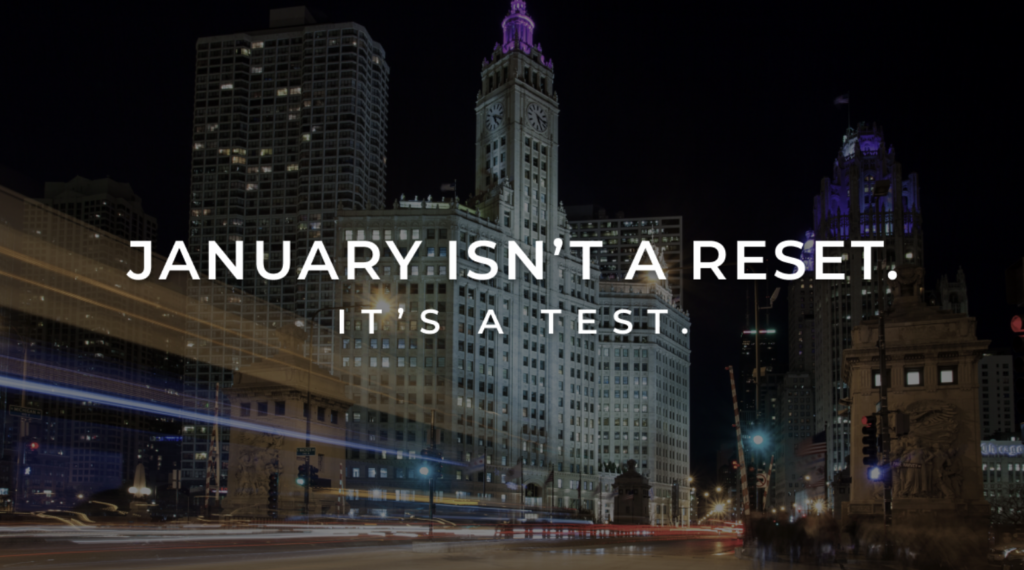
For many leaders, January feels like a reset button.
New goals.
New planners.
New language about vision and intention.
James Vasselli understands the appeal — but he doesn’t experience January that way. For him, it isn’t a clean slate. It’s a test. A test of discipline, responsiveness, and the ability to execute when the work doesn’t slow down just because the calendar says it should.
Because leadership doesn’t pause for reflection. Problems don’t wait for planning cycles. Municipalities don’t get a grace period. January doesn’t reveal who has the best ideas — it exposes who can move, decide, and deliver under pressure. Momentum isn’t something you declare at the start of the year. It’s something you prove, day after day, in how you respond when the phone rings and the stakes are real.
January doesn’t reward intention. It exposes execution.
Execution Is the Job
Execution isn’t a phase of the work for Vasselli — it is the work. In municipal law, there’s no protected planning window where problems politely wait their turn. People call with issues that didn’t exist yesterday. A development stalls. A disclosure problem surfaces. A compliance issue escalates. There’s no option to say, “Let’s table this until Q2.” You act.
That responsiveness isn’t a distraction from leadership — it’s the responsibility. Being available, decisive, and effective in real time is what clients actually experience. It’s easy to talk about momentum in January. It’s harder to sustain it when the phone doesn’t stop ringing. That’s where the test shows up.
There’s a reason movement comes up so often when Vasselli thinks about leadership. You don’t get to stand still in this role. As Arya Stark put it simply: “You have to keep moving.”
Or more bluntly: “Movement is life.” That line gets repeated in different forms because it’s true. If problems aren’t moving forward, leaders are falling behind them.
Reflection Without Stagnation
That doesn’t mean reflection doesn’t matter. It does — but only if it leads somewhere.
When Vasselli looks back at the previous year, he doesn’t start with a highlight reel or a revenue chart. He starts with harder questions. How can he get better as a person? How can the organization improve? Where were the gaps? Where did things struggle? What skills need to be developed to bridge the distance between where they are and where they want to be?
But that reflection doesn’t happen in a single, ceremonial moment between Christmas and New Year’s. There isn’t a clean line where reflection ends and action begins. For him, reflection is constant — and it’s active.
It happens at the end of a long day.
It happens in the morning when goals are set and checked later.
It happens on long car rides, replaying what worked, what didn’t, and what needs to change.
The key is this: reflection that leads to stillness becomes stagnation. Reflection that leads to adjustment becomes progress.
The Discipline of Removing, Not Adding
If January offers one real pause point, it’s deciding what not to carry forward.
There’s a quote from Rick Rubin that Vasselli returns to often: “Perfection is achieved not when there’s nothing more to add, but when there’s nothing left to take away.”
That idea applies just as much to leadership and organizations as it does to art.
Each year, the focus is on stripping away excess — systems that slow things down, habits that no longer serve the mission, and ways of working that don’t move the organization closer to its goals. The objective isn’t to do less– It’s to be more precise.
Lean. Intentional. Focused.
That refinement isn’t something you do once a year. It’s ongoing. We constantly reassess what’s working, amplify what’s effective, and learn from what isn’t. That’s how execution sharpens over time—without losing momentum.
Q1 Will Always Be Reactive — and That’s Reality
People like to talk about preventing Q1 from becoming reactive. In theory, that sounds great. In practice—especially in public-sector work—it’s almost impossible.
Emergencies don’t respect planning cycles. Water mains break. Fires happen. People get fired. Lawsuits get filed. Those realities don’t care what your roadmap looks like.
The goal isn’t to eliminate reactivity. The goal is to make sure reactivity doesn’t derail the broader mission.
You still need an overarching strategy. You still need a long-term framework that guides decisions. But you also have to accept that emergencies are part of the job. Discipline is what allows you to handle the urgent without losing sight of the important.
A Framework That Leaves Room for Judgment
When something urgent hits, Vasselli breaks it down into its smallest possible components. Every problem becomes solvable when reduced enough.
Identify the pieces.
Create an action plan.
Communicate goals clearly.
Put the right people in place.
Close the loop.
Reassess.
What worked?
What didn’t?
What needs follow-up?
The specifics change depending on the situation — but the framework stays consistent. That structure allows improvisation without chaos. It creates space between stimulus and response—and that space is where judgment, discipline, and character live.
Momentum Lives in the Small Things
One of the biggest misconceptions about leadership is that momentum comes from sweeping plans or bold declarations. In reality, momentum is built in the smallest movements.
Returning a call.
Solving a problem.
Moving one issue forward.
Clearing one obstacle.
That’s the work — especially when something new is being built.
We’re still building systems while actively serving clients. We’re building the airplane while flying it. There’s no excess time to wait for perfect conditions. And perfection isn’t the goal anyway.
Discipline—not perfection—is what keeps momentum alive.
Culture Is Character in Motion
People often ask how Vasselli models momentum for his team — how it becomes more than just an expectation placed on others. The answer is simple: example, clarity, and honesty.
We focus on solutions first. Clients don’t come to us to hear why something can’t be done. They come to find a way forward.
As J.P. Morgan famously put it:
“I don’t want a lawyer to tell me what I can’t do. I hire him to tell me how to do what I want to do legally.”
That philosophy is foundational. The means are the law. The ends are the client’s goals.
I try to instill that mindset every day: focus on the deliverable. Give clear answers. Stay compliant. Keep moving.
People like to debate work-life balance, but in this line of work, the real separator isn’t balance—it’s presence. Being fully engaged with the problem in front of you. Showing up consistently. Staying disciplined even when it’s uncomfortable.
That’s what clients see. That’s what builds trust.
Advice for Leaders Who Stall After January
If there’s one piece of advice Vasselli would offer public-sector leaders — or anyone building something new — it’s this:
Don’t get so wrapped up in your map that you forget to walk the trail.
Planning matters. Strategy matters. But action matters more. If you plan endlessly and never move, you fall behind. And once you’re always playing catch-up, momentum is incredibly hard to regain.
You need discipline. You need prioritization. And you need the willingness to act before everything feels ready
Why January Really Matters
January sets the tone not because it’s clean or quiet—but because it reveals how leaders operate under pressure.
For Vasselli, January isn’t about fresh starts. It’s about proving whether the habits, systems, and discipline you’ve built actually hold up when the work doesn’t slow down.
Momentum isn’t something you wait for. It’s something you build—call by call, decision by decision, problem by problem.
January isn’t a reset.
It’s a test.
By: Chris Bates